


The COVID-19 pandemic highlighted the urgent need for rapid, reliable, and accessible diagnostic technologies. While molecular tests such as PCR remain the gold standard, they often require specialized equipment, trained personnel, and sample preparation procedures. Researchers worldwide continue searching for simpler diagnostic approaches capable of detecting SARS-CoV-2 quickly and accurately, especially in point-of-care settings. High-quality human saliva biospecimens have become increasingly important in supporting the development and validation of these next-generation diagnostic methods. 🧪
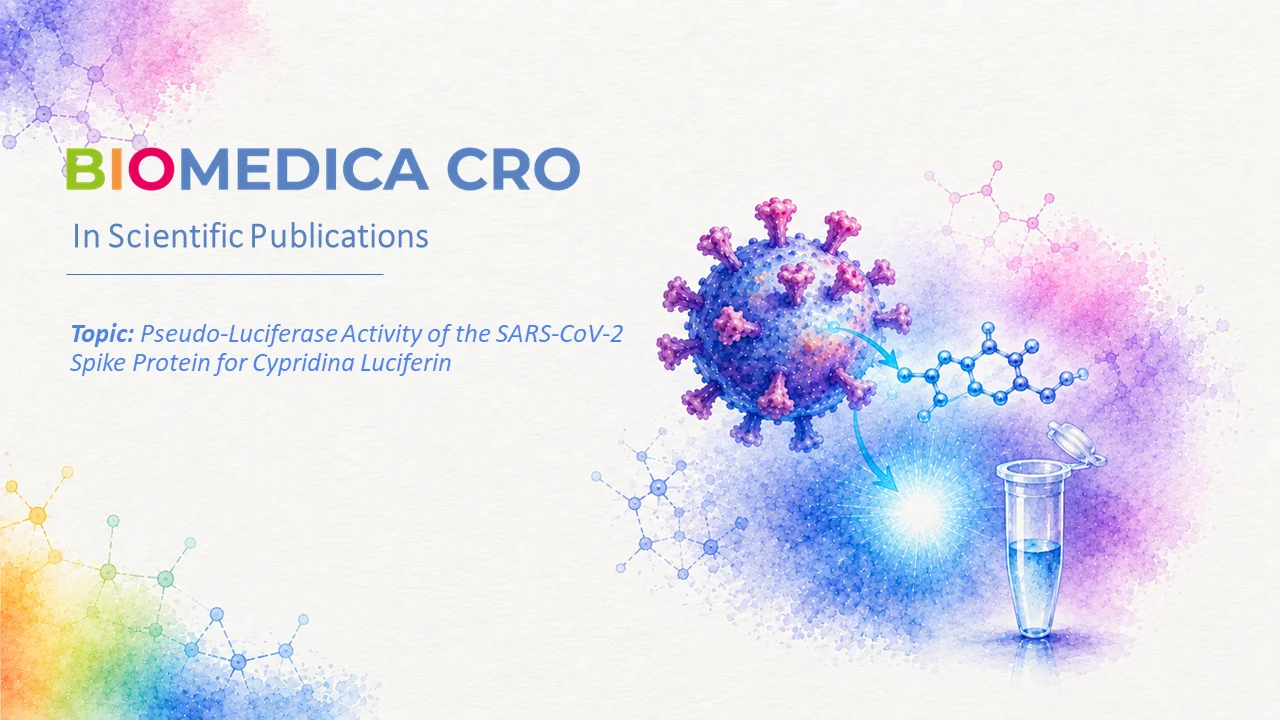
A recent publication in ACS Central Science presents an exciting discovery that could open new possibilities for rapid COVID-19 diagnostics. Scientists found that the SARS-CoV-2 spike protein itself possesses previously unknown pseudo-luciferase activity, enabling it to catalyze light emission from Cypridina luciferin without requiring conventional enzymes. The study further demonstrates the value of human saliva biospecimens as clinically relevant matrices for evaluating innovative diagnostic technologies.
The study was conducted by researchers from the National Institute of Advanced Industrial Science and Technology (AIST), Japan Science and Technology Agency (JST), Hokkaido University, RIKEN, and the University of Tsukuba, demonstrating how interdisciplinary collaboration continues to drive innovation in infectious disease diagnostics. 🌍
Importantly, the publication also acknowledges BIOMEDICA CRO as one of the biospecimen providers whose human saliva biospecimens supported this research.
💡 Discovering an Unexpected Property of the SARS-CoV-2 Spike Protein
Most diagnostic assays rely on antibodies or nucleic acid amplification to identify viral components. In contrast, this research explored whether the spike protein itself possesses unique biochemical properties that could be directly exploited for diagnostic purposes.
Remarkably, investigators demonstrated that the SARS-CoV-2 spike protein can directly catalyze luminescence of Cypridina luciferin, producing a measurable light signal without the need for traditional luciferase enzymes. This previously unknown phenomenon was described as pseudo-luciferase activity.
Building on this discovery, the research team developed a proof-of-concept diagnostic assay capable of detecting the SARS-CoV-2 spike antigen rapidly and directly in saliva samples. Unlike many existing antigen detection methods, this approach does not require antibodies, enzymatic amplification, or complex sample preparation.
The findings suggest that this novel mechanism could become the foundation for future rapid diagnostic platforms that are simpler, faster, and potentially more cost-effective than conventional testing technologies. 📈
The full publication is available here: “Pseudo-Luciferase Activity of the SARS-CoV-2 Spike Protein for Cypridina Luciferin.”
🧫 Human Saliva Biospecimens Played a Key Role in Validating the Diagnostic Approach
Innovative diagnostic concepts must ultimately demonstrate their performance using authentic human biospecimens rather than artificial laboratory solutions.
According to the publication, researchers evaluated their detection method using normal human saliva obtained from a COVID-19 PCR-negative donor. The donor was also confirmed to be negative for HIV, HBV, and HCV, and informed consent was obtained prior to sample collection.
The saliva sample served as a realistic biological matrix, allowing investigators to determine whether the spike protein could be detected directly in human saliva without prior purification or processing.
The publication identifies BIOMEDICA CRO as the provider of the human saliva biospecimens used in the study.
Access to well-characterized, ethically collected human biospecimens was essential for evaluating the proposed diagnostic approach under realistic biological conditions. Using human saliva enabled the researchers to demonstrate that the SARS-CoV-2 spike protein could be detected directly within a clinically relevant sample matrix, supporting the feasibility of this innovative antibody-free detection strategy.
This publication highlights the critical role of high-quality human biospecimens in advancing not only therapeutic research but also the development of next-generation diagnostic technologies that have the potential to improve patient care worldwide. 🚀
🧬 Flexible Prospective Biospecimen Collection for Innovative Research
Every research project has unique requirements. At BIOMEDICA CRO, we support fully customized prospective biospecimen collection studies, tailoring every project to the specific scientific and operational needs of our research partners.
Our team can adapt collection protocols, sampling schedules, laboratory consumables, collection kits, processing workflows, transport conditions, storage requirements, and clinical documentation to match virtually any study design. Whether your study requires specific collection tubes, customized processing procedures, specialized preservation media, or detailed clinical annotations, we work closely with investigators to ensure every protocol requirement is implemented with precision.
In addition to prospective collections, BIOMEDICA CRO maintains an inventory of 48,000+ banked human biospecimens, including human saliva biospecimens, blood-derived samples, tissue specimens, urine, synovial fluid, and many other sample types across numerous disease areas and normal control cohorts.
🛡️ Ethics, Consent & Human Subject Protection
All biospecimens supplied by BIOMEDICA CRO are collected in accordance with strict ethical and regulatory requirements:
- All clinical materials are obtained only after approval by an Institutional Review Board (IRB) or Independent Ethics Committee (IEC).
- Every donor voluntarily signs an Informed Consent Form (ICF) before participating in sample collection.
- All clinical data are fully anonymized prior to being shared with researchers, ensuring donor privacy and confidentiality.
- We strictly adhere to international standards governing the ethical collection and protection of human subjects in biomedical research.
Whether supporting diagnostic innovation, biomarker discovery, translational research, or drug development, BIOMEDICA CRO remains committed to delivering high-quality, ethically sourced human biospecimens while adapting every project to the unique objectives of each scientific study. 🚀
🌐 Interested? Explore our inventory of 48,000+ banked biospecimens by clicking here. Use available filters 🔍 to identify the most suitable samples and share your list with us so we can discuss tailored options for your study.
📩 Contact us: office@biomedica-cro.com.
🚀 Stay connected on LinkedIn for updates on biospecimen availability, research collaborations, and industry insights 📊.


